Euodia I exhort and Syntyche I exhort to be of the same mind in the Lord.—Phil. 4:2.

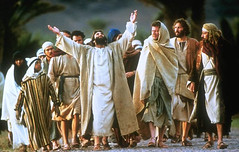
St. Paul and St. Barnabas at Lystra.Image via Wikipedia
Euodia and Syntyche, two Christian sisters in ancient Philippi, apparently had some difficulty in resolving a problem that arose between them. A heated dispute between Paul and Barnabas became public knowledge and resulted in their going separate ways for a while. (Acts 15:37-39) These accounts show that true worshippers are not immune to disagreements. Jehovah provides us with help to resolve conflicts and restore friendships. But he requires something of us. Imagine that you and a friend are going to take a trip by automobile. Before you can begin your journey, you must put a key into the ignition and start the car’s engine. The process of resolving personal differences is also started with a key. The key is humility. (Jas. 4:10) That key allows those at odds with each other to begin applying Bible principles. w09 11/15 4:15, 16
Enhanced by Zemanta

All those taking refuge in [Jehovah] will rejoice; to time indefinite they will cry out joyfully.—Ps. 5:11.

Jehovah’s Witnesses are not immune to the calamities that befall mankind in general. Many of God’s people have been victims of crime, war, and other injustices. Natural disasters, poverty, sickness, and death cause much distress. (Rom. 8:22) We are also victims of our own imperfection. (Ps. 38:4) And, like Jesus, true Christians are hated and persecuted. (Matt. 10:22, 23; John 15:20; 16:2) Does this mean that true Christians pursue a life devoid of joy and happiness? Should our lives be marked only by sadness and grief until the end comes? Clearly, Jehovah wants us to be happy as we await the fulfillment of his promises. Time and again, the Bible describes true worshippers as happy people. (Isa. 65:13, 14) Yes, it is possible to experience considerable joy, peace of mind, and contentment even in the midst of calamities. w09 12/15 2:1-3
Enhanced by Zemanta

What actually will there be for us?—Matt. 19:27.

Peter wanted to know what the future held for him and for Jesus’ other disciples. To devote themselves fully to the Kingdom-preaching work, they had made important sacrifices. (Matt. 4:18-22) What assurance did Jesus give them? Jesus indicated that his disciples would be part of a spiritual brotherhood. He said: “No one has left house or brothers or sisters or mother or father or children or fields for my sake and for the sake of the good news who will not get a hundredfold now in this period of time, houses and brothers and sisters and mothers and children and fields, with persecutions, and in the coming system of things everlasting life.” (Mark 10:29, 30) First-century Christians, such as Lydia, Aquila, Priscilla, and Gaius, were among those who provided “houses” and became “brothers and sisters and mothers” to fellow believers, as Jesus had promised.—Acts 16:14, 15; 18:2-4; 3 John 1, 5-8. w10 2/15 4:7, 8

Enhanced by Zemanta

The drawing near to God is good for me.—Ps. 73:28.

We cannot fully enjoy the benefits of being a member of Jehovah’s family without making a vow of dedication. So we dedicate ourselves to God because, in spite of our imperfection, we desire to belong to him and are resolved to be loyal to him, come what may. (Matt. 22:37) When we dedicate ourselves to God, we perform an act of faith. Why is that so? Our faith in Jehovah makes us confident that drawing close to God is good for us. We know that it will not always be easy to walk with God while living among “a crooked and twisted generation,” but we trust in God’s promise to support us in our efforts. (Phil. 2:15; 4:13) We know that we are imperfect, but we are confident that Jehovah will deal mercifully with us even when we make mistakes. (Ps. 103:13, 14; Rom. 7:21-25) We have faith that Jehovah will reward our resolve to keep our integrity.—Job 27:5. w10 1/15 1:14, 15
Enhanced by Zemanta

Make friends for yourselves by means of the unrighteous riches, so that, when such fail, they may receive you into the everlasting dwelling places.—Luke 16:9.

One way that those of the other sheep class can help Christ’s brothers is by financially supporting the preaching work. Jesus encouraged his followers to make friends for themselves by means of “the unrighteous riches.” Not that we can buy friendship with Jesus or Jehovah. Rather, by using our material assets to further Kingdom interests, we prove our friendship and love, not just in word, but “in deed and truth.” (1 John 3:16-18) We provide such financial support when we engage in the preaching work, when we donate money toward the construction and maintenance of our meeting facilities, and when we contribute funds toward the worldwide preaching work. Whether the amount we contribute is small or great, both Jehovah and Jesus certainly appreciate our cheerful giving.—2 Cor. 9:7. w09 10/15 3:17
Enhanced by Zemanta

Our being adequately qualified issues from God.—2 Cor. 3:5.

As an ordained minister, you have a ministry to perform. (Rom. 10:14) You may not feel fully qualified to shoulder such a responsibility. But, as is the case of the anointed, it is God who qualifies you. You can live up to your dedication by doing your best and relying on God’s spirit. Granted, it is not easy for us imperfect humans to live up to our dedication to our perfect God, Jehovah. One complication is that some with whom you once associated may be puzzled at your new way of life and may ‘speak abusively of you.’ (1 Pet. 4:4) Yet, do not overlook the fact that you have since cultivated new friendships, the most important being with Jehovah and Jesus Christ. (Jas. 2:21-23) It is also vital to get to know the brothers and sisters in your local congregation, part of “the whole association of brothers” throughout the world.—1 Pet. 2:17; Prov. 17:17. w10 3/15 2:14, 15
Enhanced by Zemanta

The word of God is alive and exerts power.—Heb. 4:12.

What power God’s word, or message, has! In a figurative sense, the message emanating from the Bible is sharper than any man-made sword, for it figuratively pierces to the dividing of bones and their marrow. Scriptural truth reaches the innermost part of a person and penetrates his thoughts and emotions, exposing what he really is on the inside. That truth can exert its transforming power and can bring about genuine changes in a person. (Col. 3:10) Yes, God’s Word can change lives! Moreover, the Bible is a book of matchless wisdom. It contains helpful information that can show people how to live in this complex world. (Ps. 119:105) It is a tremendous help when we are dealing with problems or are making decisions about our choice of friends, entertainment, employment, dress, and so forth.—Ps. 37:25; Prov. 13:20; John 15:14; 1 Tim. 2:9. w10 2/15 2:4, 5
Enhanced by Zemanta

Forgive whatever you have against anyone; in order that your Father who is in the heavens may also forgive you.—Mark 11:25.

Scars of a whipped slave (April 2, 1863, Baton...Image via Wikipedia
Though you were baptized in the name of the Son, you are keenly aware of your own sinful inclinations. That awareness is helpful every day. For example, if someone offends you, do you bear in mind that both of you are sinners? You both need God’s forgiveness, and you should both be forgiving. To emphasize this need, Jesus gave an illustration: The master of a slave canceled his debt of ten thousand talents (60 million denarii). Later, that slave would not release his fellow slave who owed him 100 denarii. Jesus then made this point: Jehovah will not forgive the one who does not forgive his brother. (Matt. 18:23-35) Yes, being baptized in the name of the Son means recognizing Jesus’ authority and striving to follow his example and teachings, including that of being willing to forgive others.—1 Pet. 2:21; 1 John 2:6. w10 3/15 1:12
Enhanced by Zemanta

Every good tree produces fine fruit, but every rotten tree produces worthless fruit.—Matt. 7:17.

Close-up of a cluster of large but unripe frui...Image via Wikipedia
Jesus said that those falsely professing to serve him would be distinguished from his true followers by their fruits—their teachings and their conduct. (Matt. 7:15, 16, 20) Indeed, people are inevitably influenced by what they take into their mind and heart. (Matt. 15:18, 19) Those who are fed falsehoods produce “worthless fruit,” whereas those who are taught spiritual truth produce “fine fruit.” The two kinds of fruits have become clearly manifest during this time of the end. (Dan. 12:3, 10) False Christians have a distorted view of God and often a hypocritical form of godly devotion, whereas those having spiritual insight worship God “with spirit and truth.” (John 4:24; 2 Tim. 3:1-5) Ask yourself: ‘Do my conduct and teachings clearly harmonize with God’s Word? Do I beautify the truth in the eyes of those searching for it?’ w10 1/15 3:1, 2
Enhanced by Zemanta

Do not let yourself be conquered by the evil, but keep conquering the evil with the good.—Rom. 12:21.

The apostle Paul knew from his own experience that a persecutor can become a faithful disciple of Christ and a zealous servant of Jehovah. (Gal. 1:13-16, 23) In another letter, Paul stated: “When being reviled, we bless; when being persecuted, we bear up; when being defamed, we entreat.” (1 Cor. 4:12, 13) Accordingly, a true Christian will heed the words of today’s text. The source of all evil is Satan the Devil. (John 8:44; 1 John 5:19) Jesus revealed that his anointed brothers have “conquered [Satan] because of the blood of the Lamb and because of the word of their witnessing.” (Rev. 12:11) This shows that the best way to conquer Satan and the evil influence he is exercising over the present system of things is to do good by our work of witnessing, preaching the good news of the Kingdom. w09 10/15 2:13-15
Enhanced by Zemanta

The women telling the good news are a large army.—Ps. 68:11.

By having a full share in the ministry and by willingly making sacrifices for that work, sisters prove that they treasure their role in the congregation. In writing to Titus, Paul stated: “Let the aged women be reverent in behavior, . . . teachers of what is good; that they may recall the young women to their senses to love their husbands, to love their children, to be sound in mind, chaste, workers at home, good, subjecting themselves to their own husbands, so that the word of God may not be spoken of abusively.” (Titus 2:3-5) What a force for good the mature sisters in the congregation can be! By respecting the brothers who take the lead and by making wise decisions in such areas of life as dress and grooming and entertainment, they set a fine example for others and show a high regard for their own place in the congregation. w09 11/15 3:13, 14
Enhanced by Zemanta

Your people will be my people, and your God my God.—Ruth 1:16.

Naomi entreating Ruth and Orpah to return to t...Image via WikipediaAs a girl, Ruth had probably worshiped Chemosh and the other gods of Moab, but she came to know the true God, Jehovah, and she married an Israelite who had come to take refuge in her land. (Ruth 1:1-6) Later, as Ruth and her sister-in-law, Orpah, started out with their mother-in-law, Naomi, for Bethlehem, Naomi urged the two young women to return home. It would not be easy for them to settle in Israel. Orpah indeed “returned to her people and her gods,” but Ruth did not. (Ruth 1:15) She acted on her faith and knew to whom she wanted to belong. She told Naomi: “Do not plead with me to abandon you, to turn back from accompanying you; for where you go I shall go, and where you spend the night I shall spend the night.” Because of her choice to serve Jehovah, Ruth benefited from God’s Law, which made special provision for widows and for the poor and landless. Under Jehovah’s wings, she found happiness, protection, and security. w10 1/15 2:4

Enhanced by Zemanta

He spoke with boldness . . . , giving talks and using persuasion.—Acts 19:8.

To “persuade” means to “win over.” The one persuaded is “so convinced that [he] puts confidence in something.” When we persuade a person to accept a Bible teaching, we are winning him over to place his trust in that teaching. To accomplish this, we need to convince our listener of the truthfulness of what we say. When you introduce a scripture, focus attention on the importance of knowing God’s thinking on the subject. After posing a question and getting the householder’s response, you may want to say something to this effect, ‘Let us see how we can get God’s mind on the matter.’ Or you might ask, ‘What does God have to say about this situation?’ Introducing the text in this way emphasizes that the Bible is from God and helps build high regard for it in the mind of the listener. w10 2/15 2:14, 15

Enhanced by Zemanta

I am making all things new.—Rev. 21:5.

Pueblos rojos y negros de AyllónImage by Senderismo Sermar via FlickrThose who have not as yet made a definite decision in favor of Jehovah should prayerfully consider the benefits that God’s way of ruling will bring to mankind. Human rule has been unable to solve the problem of crime, including terrorism. God’s rule will remove all the wicked from the earthly scene. (Ps. 37:1, 2, 9) Man’s rule has led to incessant warfare, but God’s rule will make “wars to cease to the extremity of the earth.” (Ps. 46:9) Why, God’s rule will even restore peace between humans and animals! (Isa. 11:6-9) Poverty and hunger have been constant features under human rule, but God’s rule will eliminate them. (Isa. 65:21) Under God’s rule, the old and the sick will delight in a return to youthful vigor. (Job 33:25; Isa. 35:5, 6) Indeed, the earth will become a paradise in which there will even be a resurrection of the dead.—Luke 23:43; Acts 24:15. w10 1/15 5:16, 17


Enhanced by Zemanta

O the depth of God’s riches and wisdom and knowledge! How unsearchable his judgments are and past tracing out his ways are!—Rom. 11:33.

Immediately after Adam and Eve sinned, Jehovah revealed the way that he would undo all the bad effects caused by their rebellion. (Gen. 3:15) Such immediate action, as well as his progressively revealing details of this purpose to his servants, brought Jehovah’s wisdom into sharp focus. Nothing can impede God’s ability to handle matters successfully. In a world marked by immorality, war, unreasonableness, disobedience, mercilessness, partiality, and hypocrisy, Jehovah has had ample opportunity to demonstrate to his creatures what real wisdom is. The disciple James said: “The wisdom from above is first of all chaste, then peaceable, reasonable, ready to obey, full of mercy and good fruits, not making partial distinctions, not hypocritical.”—Jas. 3:17. w10 1/15 4:14

Enhanced by Zemanta

Follow the course of hospitality.—Rom. 12:13.

The Ten Commandments, In SVGImage via WikipediaHospitality is sometimes expressed by inviting someone for a meal, and when this is done in love, it is commendable. But if we show initiative, we will discover many other ways of being hospitable. For one thing, if our means or our strength do not allow us to invite others for a meal, sharing a cup of coffee, tea, or some other beverage is also a way of showing hospitality. Christians who strive to learn another language so as to preach the good news among foreigners who have moved into the territory of their congregation can truly be counted among those who are following the course of hospitality. Of course, many of us are not in a position to learn another language. Still, all of us can have a meaningful share in helping foreigners by making good use of our booklet Good News for People of All Nations, which contains a Bible message in many languages. w09 10/15 1:12-14

Enhanced by Zemanta

For everything there is an appointed time.—Eccl. 3:1.

When we are being represented in public prayer, we need to display reverential “fear of God.” (1 Pet. 2:17) There may be a proper time and place for some actions that would be inappropriate at a Christian meeting. For instance, suppose someone sought to have all in a group link arms or hold hands during such a prayer. This might offend or distract some, including visitors who do not share our beliefs. Some marriage mates might discreetly hold hands, but if they embraced each other during public prayer, those who got a glimpse of such conduct might be stumbled. They might think or get the impression that the couple was focusing on their romantic relationship instead of reverence for Jehovah. Out of deep respect for him, let us therefore “do all things for God’s glory” and avoid conduct that could distract, shock, or stumble anyone.—1 Cor. 10:31, 32; 2 Cor. 6:3. w09 11/15 1:19

Enhanced by Zemanta

The two will be one flesh.—Matt. 19:5.

the Gospel of MatthewImage by humberpike via FlickrMarriage is a relationship that requires a high level of commitment. Two people who merely live together without getting married can never enjoy real security; neither can their children. But partners who are committed to each other in honorable marriage have an impelling Scriptural reason for striving to resolve their difficulties with love when problems arise. (Matt. 19:6; 1 Cor. 13:7, 8; Heb. 13:4) In Bible times, people benefited from having binding contracts in business and employment. (Matt. 20:1, 2, 8) Today, the same holds true. For example, we benefit from having a binding written agreement, or written contract, before we begin a business venture or start working as an employee in a company. Hence, if commitment enhances relationships such as friendship, marriage, and employment, how much more will making an unreserved dedication benefit you in your relationship with Jehovah! w10 1/15 1:6, 7

Enhanced by Zemanta

You must love your neighbor as yourself.—Matt. 22:39.

Kingdom Hall of Jehovah's Witnesses, Lana‘i CityImage by Joel Abroad via FlickrThat love (a‧ga′pe in Greek) is a moral love that takes into account duty, principle, and propriety, but it can be warm and intense. (1 Pet. 1:22) It is reflected in selfless words and deeds. (1 Cor. 13:4-7) Because love is a product of God’s holy spirit, it enables true Christians to do what others cannot do, such as overcome racial, cultural, and political barriers. (John 13:34, 35; Gal. 5:22) Sheeplike ones cannot help but be moved when they see such love. For example, when a young Jewish man in Israel attended his first Christian meeting, he was amazed to see Jewish and Arab brothers worshipping Jehovah side by side. As a result, he began to attend meetings regularly and accepted a Bible study. Do you show such heartfelt love to your brothers? And do you make it a point to extend a warm welcome to newcomers at your Kingdom Hall, regardless of their nationality, skin color, or social standing? w10 1/15 3:18, 19

Enhanced by Zemanta